Surah Muhammad


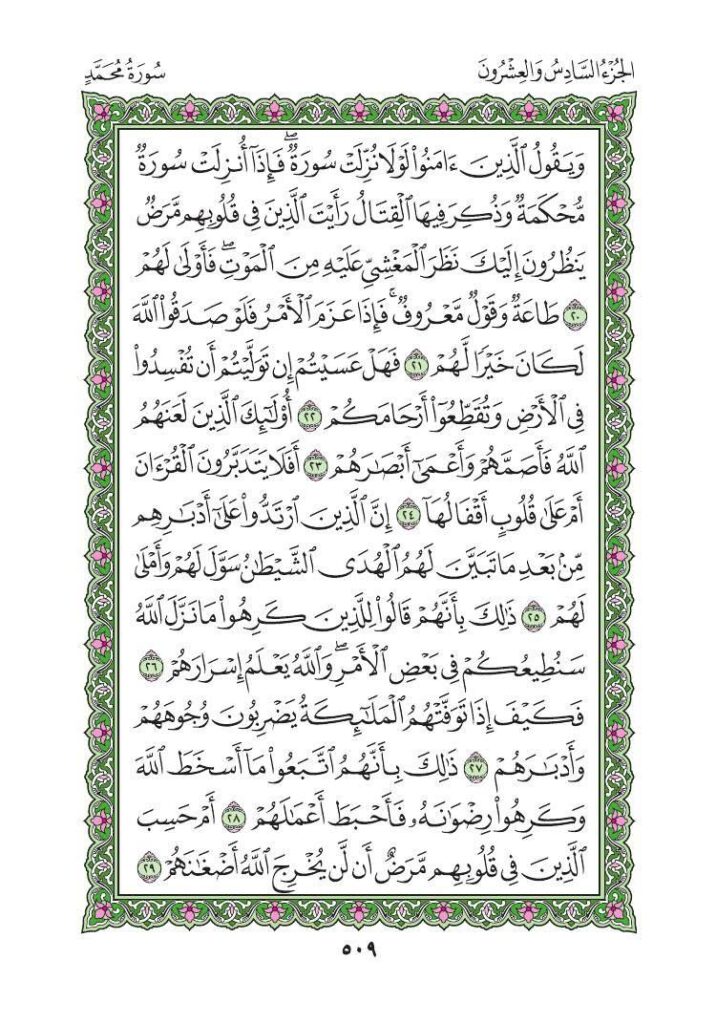

Surah Muhammad (Arabic: سورة محمد) is the 47th chapter of the Holy Qur’an. It is a Madani Surah consisting of 38 verses.
Unlike the previous Ha-Mim Surahs, this Surah was revealed in Madinah, where Muslims were now establishing a society, facing military challenges, and building a structured Islamic state.
The Surah is named after Prophet Muhammad ﷺ in verse 2, where his blessed name appears directly.
This Surah focuses on:
- Belief vs disbelief in practical life
- Rules of war and struggle (Jihad context)
- Support for the Prophet ﷺ
- Rewards of believers and punishment of hypocrites and disbelievers
- Strengthening faith and obedience
Basic Information about Surah Muhammad
- Surah Number: 47
- Number of Verses: 38
- Makki or Madani: Madani
- Juz: 26
- Revelation Context: Early Madinan period
Meaning and Significance of Surah Muhammad
This Surah is unique because it:
- Mentions the Prophet ﷺ by name explicitly
- Establishes clear distinctions between belief and disbelief
- Provides guidance for an active Muslim society
It teaches that:
Faith is not only belief in the heart — it must reflect in actions, sacrifice, and obedience to Allah.
Historical Context of Revelation
Surah Muhammad was revealed during a time when:
- Muslims were facing threats from Quraysh
- The Battle of Badr and early conflicts were shaping the Muslim community
- Hypocrites (Munafiqun) were emerging in Madinah
The Surah addresses:
- External enemies (disbelievers)
- Internal weakness (hypocrisy)
- Strengthening the Muslim community
Central Themes of Surah Muhammad
1. The Contrast Between Believers and Disbelievers
The Surah clearly divides humanity into two groups:
Believers:
- Accept truth
- Perform good deeds
- Support Islam
- Receive divine mercy
Disbelievers:
- Reject truth
- Follow falsehood
- Oppose Islam
- Face destruction
2. Support for the Prophet Muhammad ﷺ
Allah commands believers to:
- Follow the Prophet ﷺ
- Support his mission
- Defend the truth he brought
It emphasizes that:
Obedience to the Prophet ﷺ is obedience to Allah.
3. The Concept of Struggle (Jihad Context)
The Surah discusses struggle in the path of Allah in the context of:
- Defending the Muslim community
- Protecting faith and justice
- Standing against oppression
It is important to understand:
- This is not aggression
- It is defensive and moral struggle for justice
4. Actions and Accountability
A key message is:
Good deeds benefit believers, while disbelief leads to loss.
The Surah explains that:
- Allah does not wrong anyone
- Humans wrong themselves through actions
5. Hypocrisy (Munafiqeen)
The Surah strongly warns about hypocrites who:
- Pretend to believe
- Support disbelievers secretly
- Spread corruption
Allah exposes their reality and warns of punishment.
6. Reward of Paradise vs Punishment of Hell
The Surah describes:
Paradise:
- Rivers of pure water
- Milk and honey
- Eternal peace
- Forgiveness from Allah
Hell:
- Burning punishment
- Regret and humiliation
- No escape or helpers
Tafsir of Key Verses (Simplified Explanation)
Verses 1–3: Those who disbelieve and obstruct truth
Their deeds are wasted because they rejected guidance.
Verses 4–6: Support in struggle
Believers are encouraged to remain firm and support truth.
Verses 7–11: Victory for those who support Allah
Allah promises help to those who help His religion.
Verses 12–15: Description of Paradise
A vivid comparison between Paradise and Hell is given.
Verses 16–19: Hypocrites exposed
Those with weak hearts are warned.
Verses 20–24: True believers are identified
They are those who reflect, obey, and act sincerely.
Verses 25–30: Warning to hypocrites
Their hidden intentions will be exposed by Allah.
Verses 31–38: Final warning and call to obedience
Believers are reminded not to weaken or compromise.
Key Lessons from Surah Muhammad
1. Faith must be practical
Islam is not only belief — it requires action.
2. Supporting truth brings success
Those who support Allah’s religion receive divine help.
3. Hypocrisy destroys inner faith
Pretending to believe leads to spiritual ruin.
4. Life is a test of sincerity
Every action reveals true intention.
5. Paradise is for those who remain steadfast
Consistency in faith leads to eternal reward.
Spiritual and Practical Benefits
Surah Muhammad strengthens:
- Commitment to Islamic values
- Awareness of sincerity
- Courage in facing trials
- Understanding of accountability
- Motivation for righteous action
Practical application:
- Be honest in faith and actions
- Avoid hypocrisy in behavior
- Support truth in society
- Stay firm during trials
Connection with Previous Surahs
Surah Muhammad follows Surah Al-Ahqaf (46) and shifts from Makkan themes to Madinan reality:
- Surah Al-Ahqaf → Warning, past nations, faith
- Surah Muhammad → Action, community, struggle
This shows a transition:
From belief to implementation.
Conclusion
Surah Muhammad teaches that:
- Faith must be active, not passive
- Supporting truth leads to divine help
- Hypocrisy is a serious spiritual disease
- Paradise is the reward for sincerity and struggle
It is a Surah that builds a strong, disciplined, and faithful community centered on obedience to Allah and His Messenger ﷺ.
Allah knows best.
