Surah Abasa
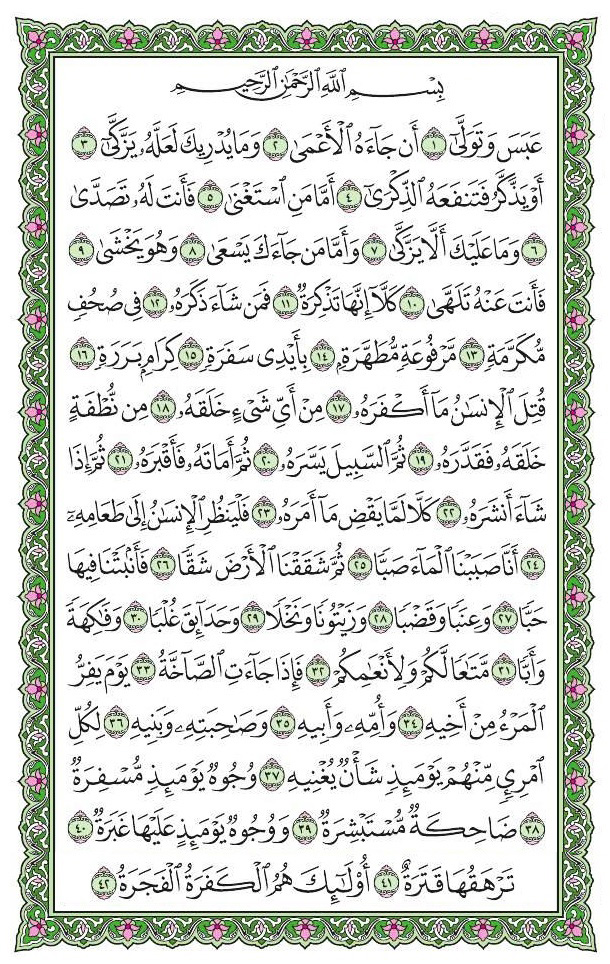
Surah ‘Abasa (Arabic: سورة عبس) is the 80th chapter of the Holy Qur’an. It consists of 42 verses and is a Makki Surah located in Juz 30.
The name ‘Abasa means “He frowned”, taken from the opening verse describing an incident involving the Prophet Muhammad ﷺ and a blind companion, Abdullah ibn Umm Maktum (RA).
This Surah is unique because it:
- Corrects gentle human behavior in da’wah
- Emphasizes equality in seeking guidance
- Highlights the value of sincere seekers of truth
- Warns against arrogance toward the poor
- Reminds humanity of creation and resurrection
It is a Surah of divine moral refinement.
Basic Information About Surah ‘Abasa
| Detail | Information |
|---|---|
| Surah Name | ‘Abasa (He Frowned) |
| Surah Number | 80 |
| Total Verses | 42 |
| Revelation | Makki |
| Juz | 30 |
| Main Theme | Guidance, humility, equality, resurrection |
Meaning of “‘Abasa”
The word ‘Abasa (عبس) means:
“He frowned” or “He showed displeasure”
It refers to the moment when the Prophet ﷺ was speaking to the leaders of Quraysh, and a blind companion interrupted seeking guidance.
Allah gently corrected this moment to teach a timeless principle:
Those who sincerely seek guidance are more important than those who turn away arrogantly.
Historical Background of Surah ‘Abasa
The incident:
- The Prophet ﷺ was addressing powerful leaders of Makkah
- He hoped they would accept Islam
- Abdullah ibn Umm Maktum (RA), a blind companion, came asking for guidance
- The Prophet ﷺ showed slight displeasure due to interruption
Allah revealed this Surah to teach:
- Prioritize sincerity over status
- Never ignore sincere seekers
- Guidance is not tied to wealth or power
Central Theme of Surah ‘Abasa
The main message is:
True value lies in sincerity and humility, not social status or wealth.
The Surah focuses on:
- Equality in seeking guidance
- Human creation and dependence on Allah
- The reality of resurrection
- The consequences of arrogance
Major Themes of Surah ‘Abasa
1. Importance of Sincere Seekers of Truth
Allah reminds:
- The blind companion came seeking guidance
- He had sincere intention
- He deserved attention more than arrogant leaders
Lesson
Sincerity is more valuable than status.
2. Equality in Islam
Islam teaches:
- No superiority based on wealth
- No preference based on power
- Honor is based on taqwa (righteousness)
3. Warning to Arrogant Leaders
The Surah criticizes those who:
- Feel self-sufficient
- Reject guidance
- Turn away from truth
4. Human Creation
Allah reminds:
- Humans are created from a drop of fluid
- Then shaped and guided
- Yet they become arrogant
5. Provision from Allah
Allah provides:
- Food from the earth
- Water from the sky
- Sustenance for all creatures
This shows:
Dependence on Allah is complete.
6. Reality of Resurrection
On the Day of Judgment:
- People will flee from family
- Everyone will worry about themselves
- No one will help another
7. Faces on the Day of Judgment
Two groups:
Bright faces
- Happy
- Joyful
- Rewarded with Paradise
Darkened faces
- Fearful
- Regretful
- Facing punishment
8. Reminder of Divine Power
Allah shows:
- Creation of earth
- Growth of food
- Balance of nature
- Perfect design of life
9. Accountability of Human Actions
Every action:
- Will be recorded
- Will be judged
- Cannot be escaped
10. Final Warning
The Surah ends with:
A reminder that guidance is clear, but not everyone accepts it.
Tafsir of Key Sections
Verses 1–10
Correction of behavior and importance of sincerity.
Verses 11–16
Reminder that the Qur’an is guidance for those who fear Allah.
Verses 17–23
Human creation and dependence on Allah.
Verses 24–32
Provision of food and signs in nature.
Verses 33–42
Day of Judgment and final separation of people.
Major Lessons from Surah ‘Abasa
1. Sincerity matters more than status
Allah values intention over rank.
2. Everyone is equal before Allah
Wealth and power have no value in guidance.
3. Arrogance blocks truth
Self-sufficiency leads to misguidance.
4. Humans are weak and dependent
We rely completely on Allah.
5. Resurrection is certain
Every soul will be raised again.
6. Accountability is unavoidable
Every action will be judged.
7. Guidance is a mercy
It is given to those who seek it sincerely.
Benefits of Reflecting on Surah ‘Abasa
This Surah helps believers:
- Develop humility
- Respect sincere seekers
- Remove arrogance
- Strengthen belief in the Hereafter
- Appreciate Allah’s blessings
- Improve moral character
Connection with Previous Surah
Surah An-Nazi’at (79)
Focused on:
- Death
- Pharaoh’s arrogance
- Resurrection
- Accountability
Surah ‘Abasa (80)
Focuses on:
- Human behavior in guidance
- Importance of sincerity
- Moral correction
Together they show:
External arrogance leads to destruction, internal arrogance blocks guidance.
Why Surah ‘Abasa Matters Today
In modern life:
- People are judged by status
- Poor are ignored
- Arrogance is common
- Sincerity is overlooked
This Surah teaches:
- Respect everyone equally
- Value sincere intentions
- Avoid pride in knowledge or wealth
- Focus on true guidance
Conclusion
Surah ‘Abasa is a powerful Surah that teaches humility, equality, and sincerity in seeking truth.
It reminds humanity that:
- Allah values sincerity, not status
- Guidance belongs to those who seek it
- Arrogance leads to loss
- Human beings are dependent on Allah
- Resurrection and accountability are certain
It is a Surah of moral correction and spiritual refinement.
May Allah grant us humility, sincerity, and the ability to always accept truth with open hearts. Ameen.
