Meditation
Surah Rahman Muraqabah by Peer Syed Safdar Ali Bukhari

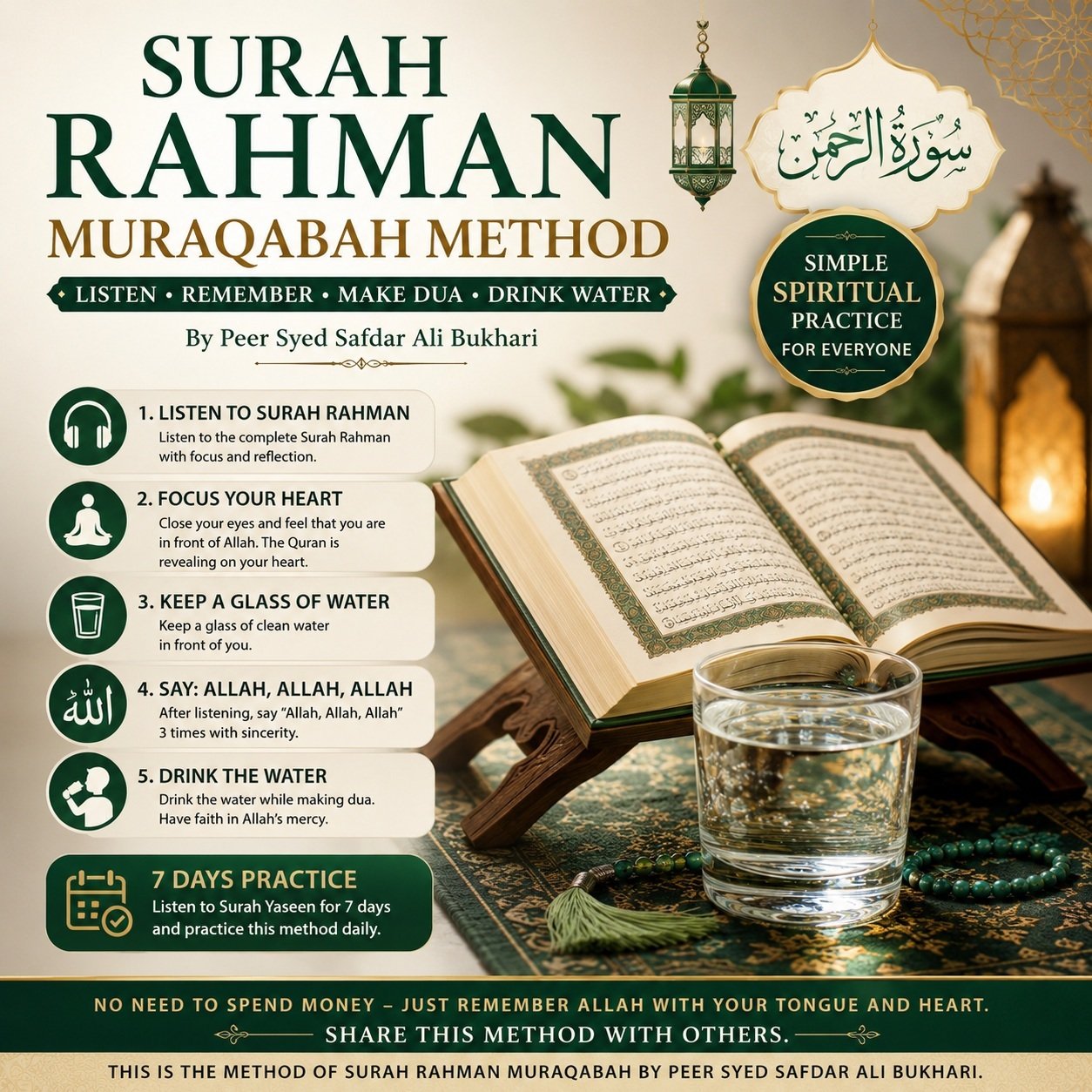
Surah Rahman Muraqabah is a spiritual practice described by Peer Syed Safdar Ali Bukhari that focuses on listening to Surah Ar-Rahman, remembering Allah, making sincere dua, and drinking water with faith and hope in Allah’s mercy.
Many people look for spiritual methods that are simple, accessible, and do not require spending money. This method is presented as a way for a person to sit quietly, remember Allah, listen to the Quran, and turn their heart toward Him.
The purpose of muraqabah is not to perform a complicated ritual. It is to create a moment of concentration, remembrance, reflection, and dua.
What Is Surah Rahman Muraqabah?
Muraqabah can be understood as a state of focused spiritual reflection and awareness of Allah.
In the Surah Rahman Muraqabah method, a person listens to the recitation of Surah Ar-Rahman in a quiet environment and concentrates on the words of the Quran.
The person closes their eyes if that helps them concentrate and imagines themselves turning completely toward Allah in humility and prayer.
This should not mean imagining Allah in a physical form. Allah is beyond human imagination and cannot be represented by a mental picture.
Instead, the person focuses their heart on Allah’s greatness, mercy, blessings, and presence while listening to His words.
The Quran becomes the center of attention, while the heart turns toward Allah through remembrance and dua.
How to Perform Surah Rahman Muraqabah
The practice can be performed in a quiet and peaceful place.
Step 1: Find a Quiet Place
Choose a place where you can sit comfortably without unnecessary distractions.
You may perform the practice after Wudu if you wish.
Turn off unnecessary notifications and give yourself enough time to listen to the recitation without interruption.
Step 2: Keep a Glass of Water
Place a glass of clean drinking water in front of you or beside you.
The water is simply part of the practice described here. Remember that water itself does not possess independent healing power.
Any benefit, blessing, or healing ultimately comes from Allah.
Step 3: Close Your Eyes
Close your eyes if doing so helps you concentrate.
Relax and try to remove unnecessary thoughts from your mind.
Focus your attention on Allah and the Quran.
You may reflect upon the mercy and greatness of Allah and the countless blessings that He has given to humanity.
Step 4: Listen to the Complete Surah Rahman
Play the complete recitation of Surah Ar-Rahman.
Listen carefully from beginning to end.
Rather than simply hearing the recitation in the background, try to listen with attention and reflection.
If possible, read the translation or learn the meaning of the verses so that your reflection becomes deeper.
Surah Rahman repeatedly reminds us of the blessings of Allah and encourages us to recognize His mercy and favors.
Step 5: Remember Allah
After completing the recitation, remember Allah sincerely.
According to the method attributed to Peer Syed Safdar Ali Bukhari, a person may say:
Allah, Allah, Allah
The words should be spoken sincerely and with attention.
The purpose is remembrance of Allah rather than treating the words as a magical formula.
Step 6: Drink the Water
After the recitation and remembrance, drink the water.
While drinking, make sincere dua to Allah.
You can ask Allah for:
- Good health
- Peace of mind
- Protection
- Forgiveness
- Guidance
- Mercy
- Strength
- Relief from difficulties
- Blessings in your life
You may say a simple dua such as:
“Ya Allah, grant me health, peace, mercy and well-being. Remove my difficulties and grant me what is best for me.”
The most important part is sincerity.
What About the Seven-Day Practice?
Some people may wish to make listening to Surah Rahman a regular practice for seven days.
You can listen to the complete Surah Rahman each day for seven days as a personal spiritual routine.
During those seven days, try to maintain concentration and reflect upon the meaning of the Quran.
A simple routine could be:
Day 1: Listen to Surah Rahman and make dua.
Day 2: Listen again and reflect on Allah’s blessings.
Day 3: Focus on gratitude and remembrance.
Day 4: Ask Allah for guidance and forgiveness.
Day 5: Pray for yourself and your family.
Day 6: Ask Allah for peace, strength, and well-being.
Day 7: Complete the recitation and make sincere dua, placing your trust in Allah.
However, the seven-day period should be understood as a personal routine, not automatically as a religious requirement or a guaranteed formula unless supported by reliable Islamic evidence.
A person may continue listening to the Quran beyond seven days.
What If Someone Cannot Perform the Full Muraqabah?
Not everyone can sit quietly for a long period.
Some people may be elderly, busy, physically uncomfortable, or simply unable to concentrate during a full muraqabah session.
For such people, the practice can be kept simple.
Take a glass of water.
Sit peacefully.
Remember Allah by saying:
Allah, Allah, Allah
Then make your dua and drink the water.
There is no need to make the practice unnecessarily complicated.
The person can remember Allah with their own tongue and turn their heart toward Him.
You Do Not Need to Spend Money
One of the simple aspects emphasized in this teaching is that a person does not need expensive products, special equipment, or paid services to remember Allah.
The remembrance of Allah can be done with one’s own tongue.
The Quran can be listened to.
Dua can be made directly to Allah.
A glass of ordinary drinking water can be used as part of this personal practice.
There should be no need to exploit vulnerable people by promising guaranteed supernatural results or charging them large amounts of money for a spiritual practice.
Can the Water Become Aab-e-Shifa?
Some people describe spiritually prepared water as Aab-e-Shifa, meaning water associated with healing or seeking healing from Allah.
It is important to understand this correctly.
A person may make dua to Allah and ask Him to place benefit and healing in something. However, ordinary water should not literally be claimed to have become Zamzam water through this practice.
Zamzam has a unique status as the blessed water from the well of Zamzam in Makkah.
Therefore, this practice should not be described as transforming ordinary water into Zamzam.
Instead, a believer can drink water while making dua and asking Allah for healing, mercy, and blessing.
Allah is the ultimate source of healing.
What Does Healing Mean in This Practice?
When a person practices Surah Rahman Muraqabah, they may experience spiritual comfort, calmness, hope, gratitude, and a stronger connection with Allah.
Some people may also feel emotionally encouraged by regular Quran recitation and dua.
However, no spiritual practice should be presented as a guaranteed treatment for every physical or psychological illness.
If someone is suffering from a medical condition, they should seek appropriate medical care from a qualified healthcare professional.
Dua and Quran recitation can be part of a person’s spiritual life, but they should not be used as a reason to abandon necessary medical treatment.
Have Faith in Allah
The heart of this practice is Tawakkul — placing one’s trust in Allah.
When you make dua, you may ask Allah for exactly what you need.
But at the same time, leave the final outcome to Him.
You may ask:
“Ya Allah, if this is good for me, grant it to me. If something else is better for me, guide me toward what is better.”
This attitude prevents a person from treating a spiritual practice as a guaranteed formula.
The believer asks Allah and trusts His wisdom.
Teach the Method to Others
If someone learns this practice and wishes to share it with others, they can teach it freely.
There is no need to turn the remembrance of Allah into an expensive service.
You can tell another person:
Listen to the Quran.
Remember Allah.
Make sincere dua.
Ask Allah for health and well-being.
Drink water.
And place your trust in Allah.
If someone feels that the practice has brought them spiritual comfort or benefit, they can share their experience with others while remembering that Allah is the One who grants benefit and healing.
Personal experiences should not be presented as guaranteed results for everyone.
A Simple Daily Routine
For someone who wants a simple routine, the practice can look like this:
1. Sit in a quiet place.
2. Keep a glass of drinking water nearby.
3. Close your eyes if it helps you concentrate.
4. Turn your attention toward Allah.
5. Listen to the complete recitation of Surah Rahman.
6. Reflect upon the meaning and blessings mentioned in the Surah.
7. Say Allah, Allah, Allah with sincere remembrance.
8. Make your personal dua.
9. Drink the water.
10. Continue your normal prayers, Quran recitation, and acts of worship.
The practice can be repeated regularly as a personal spiritual routine.
A Reminder About Muraqabah
Muraqabah should not become a substitute for the fundamentals of Islam.
A person should continue to observe their obligatory prayers, fulfill their responsibilities, avoid prohibited actions, and maintain a sincere relationship with Allah.
Listening to Surah Rahman is beautiful, but the Quran is not meant only to be listened to for a particular result.
It is guidance for life.
Its message should influence our character, gratitude, patience, behavior, and relationship with Allah.
Surah Rahman and Gratitude
One of the most powerful themes of Surah Rahman is the recognition of Allah’s blessings.
When a person listens carefully, they are reminded again and again of the countless favors Allah has provided.
This can encourage a person to move away from constant worry and toward gratitude.
Instead of focusing only on what we do not have, we can remember what Allah has already given us:
Our life.
Our ability to breathe.
Our families.
Our opportunities.
Our food and water.
Our ability to pray.
Our ability to ask Allah for help.
Gratitude itself can transform the way a person approaches life.
The Message of Surah Rahman Muraqabah
The central message of this practice is not that a particular ritual can control the outcome of life.
The message is much simpler:
Turn toward Allah.
Listen to His Quran.
Remember Him.
Make sincere dua.
Be grateful for His blessings.
Ask Him for healing and mercy.
Trust His decision.
And when you experience comfort or benefit, share goodness with others without exploiting their difficulties.
Final Words
Surah Rahman Muraqabah, as described by Peer Syed Safdar Ali Bukhari, is presented as a simple spiritual method involving Quranic recitation, remembrance of Allah, dua, and drinking water.
For those who can perform the complete muraqabah, they can sit quietly, listen to the complete Surah Rahman, reflect upon its message, remember Allah, make dua, and drink the water.
For those who cannot perform the complete meditation, they can keep the practice simple by remembering Allah, saying:
Allah, Allah, Allah
and making sincere dua before drinking the water.
There is no need to spend large amounts of money to remember Allah.
The tongue can remember Him.
The heart can turn toward Him.
The Quran can be listened to and reflected upon.
And dua can be made directly to Allah.
Most importantly, remember that healing and benefit ultimately come from Allah.
Practice with sincerity, hope, humility, and Tawakkul.
And if you are dealing with an illness, seek appropriate medical care alongside your spiritual practices.
May Allah grant us health, peace, guidance, mercy, forgiveness, and a heart that remains connected to Him. Ameen.

-

 Blog2 years ago
Surah Muzammil
-

 Blog1 year ago
Nazar Ki Dua by Prophet ﷺ
-

 Blog1 year ago
Surah Yaseen
-

 Blog2 years ago
Surah Nasr
-

 Blog2 years ago
Nazar Ki Dua
-

 Blog2 years ago
Surah Yaseen: The Heart of the Quran and Its Blessings
-

 Dua1 year ago
Dua for Protection, Powerful Islamic Prayers for Daily Safety from Enemies and Evil
-

 Blog2 years ago
Evil Eye Protection, Symptoms, Remedies & Removal?